Postdoctoral Researcher @ University of Wisconsin–Madison
I am a theoretical physicist studying high-energy physics, string theory, and cosmology.
I also explore how machine learning and AI can help us tackle problems across physics,
mathematics, and engineering.
I often think while walking, a habit I call Thinking While Walking. To me, my mind is my laboratory. Through thought alone,
I can explore the vastness of the universe and delve into the microscopic quantum world. I believe this is the most romantic thing.
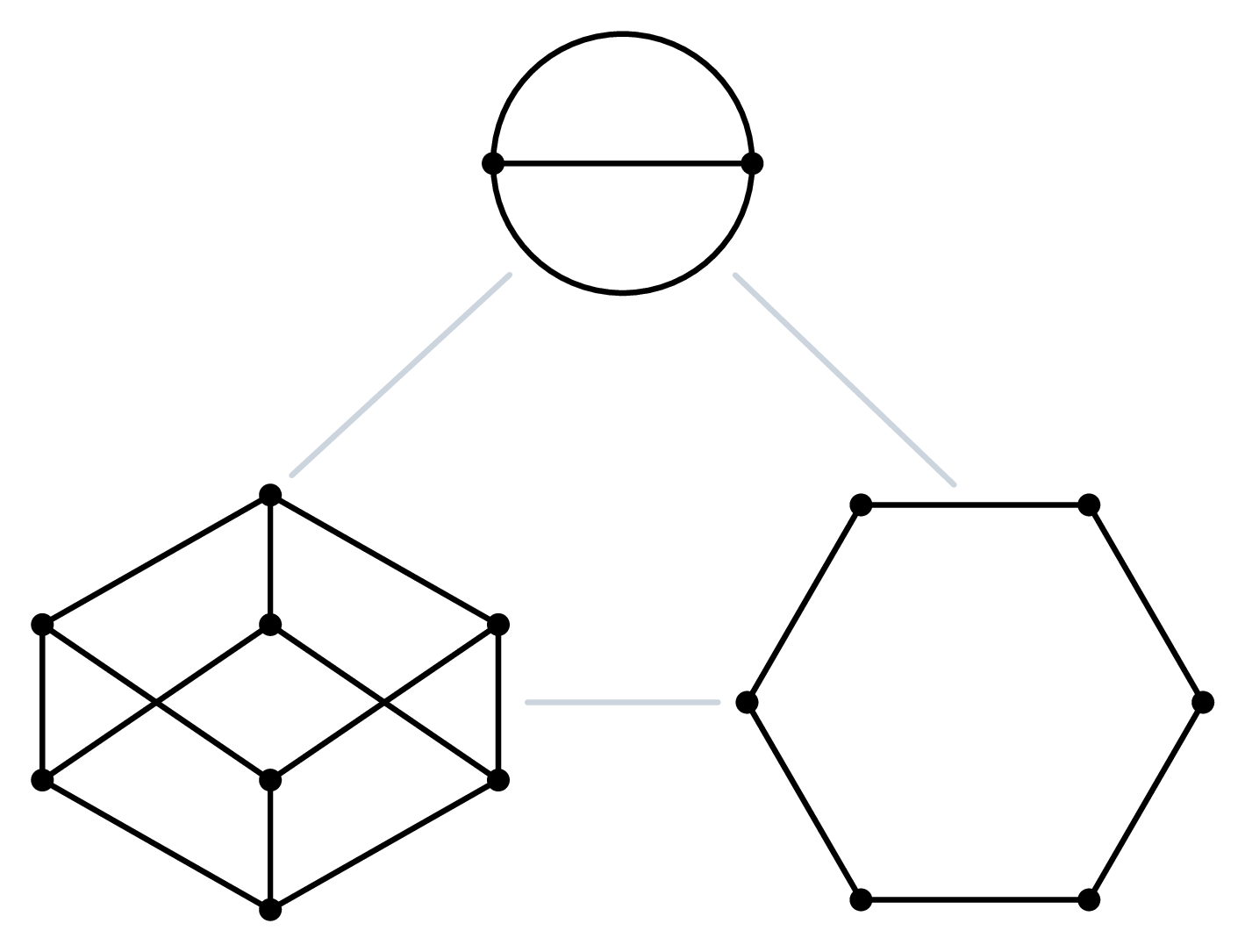
From Trees to All Loops: The Combinatorial Geometry of Two-Site Cosmological Wavefunctions
Yanfeng Hang, et al. •
An all-loop construction expresses two-site cosmological wavefunction coefficients as sums of
tree-level terms evaluated at shifted energies, including arbitrary tadpole contributions. The
underlying geometry links Boolean lattices and permutohedra with finite differences, maximal
chains, and graph tubings. These relations also apply to power-law FRW cosmologies before
spatial loop-momentum integration.
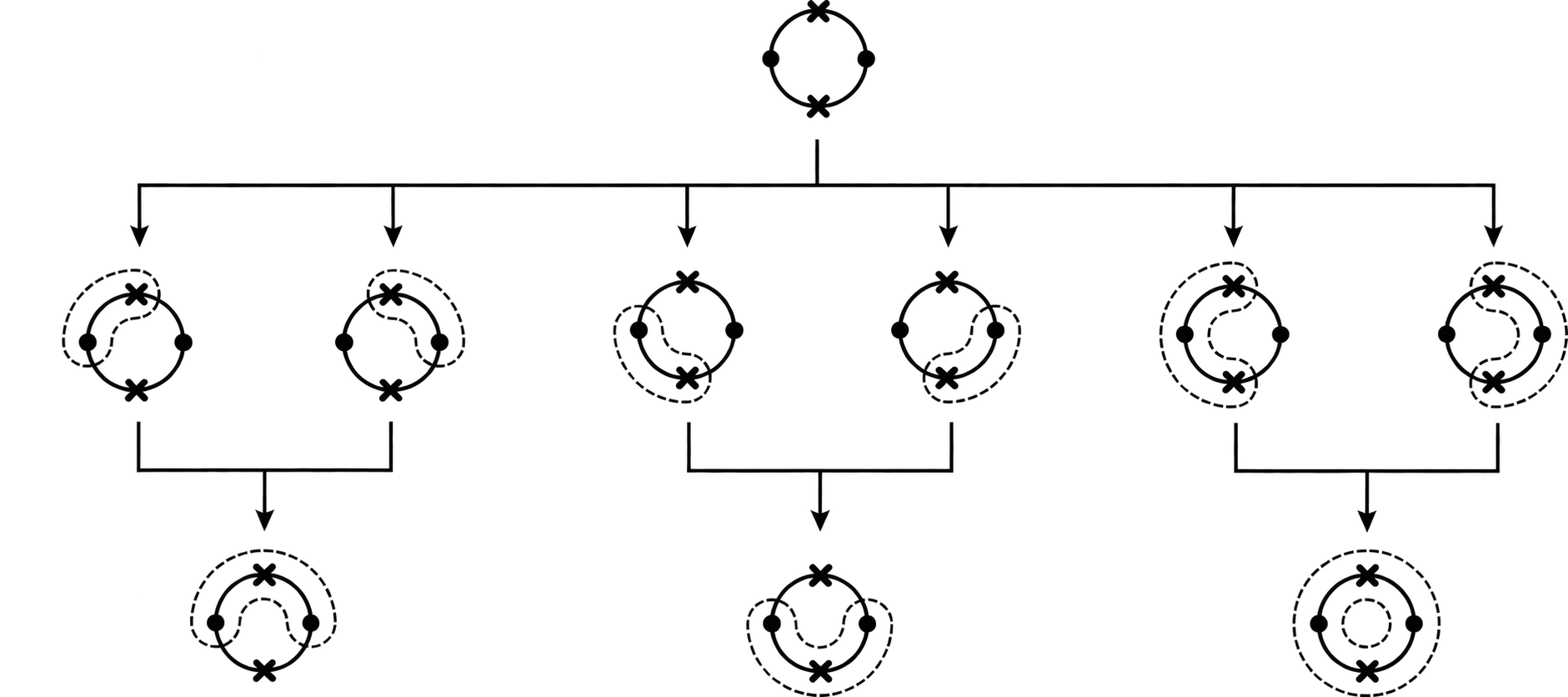
A Note on Kinematic Flow and Differential Equations for Two-Site One-Loop Graph in FRW Spacetime
Yanfeng Hang, et al. •
Canonical differential equations for two-site one-loop bubble and tadpole diagrams extend
kinematic flow to loop-level cosmological integrals in power-law FRW backgrounds. Twisted
cohomology, integration-by-parts techniques, and marked tubing graphs reveal the distinct
structures of these systems. The analysis also proposes an all-loop decomposition into shifted
tree-level and bubble-like building blocks.
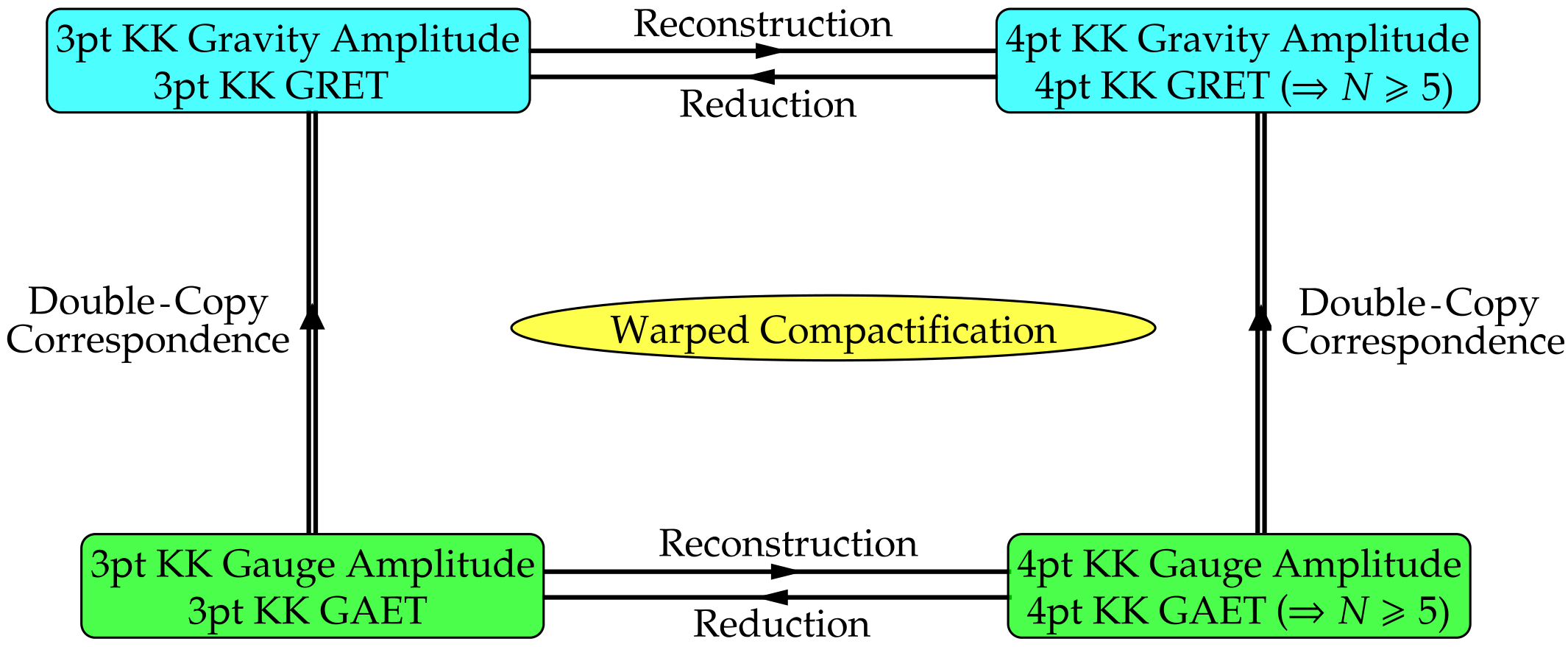
Structure of Massive Gauge/Gravity Scattering Amplitudes, Equivalence Theorems, and Extended Double-Copy with Compactified Warped Space
Yanfeng Hang, et al. •
Gauge and gravitational equivalence theorems connect massive Kaluza-Klein scattering
amplitudes to their Goldstone counterparts in compactified warped geometries. The relations
hold for three- and four-point tree amplitudes and support a double-copy construction that is
exact at three points and captures the leading high-energy behavior at four points.
Structure of Kaluza-Klein Graviton Scattering Amplitudes from Gravitational Equivalence Theorem and Double-Copy
Yanfeng Hang, et al. •
At high energies, longitudinal Kaluza-Klein graviton amplitudes are related to their Goldstone
counterparts by a gravitational equivalence theorem in compactified five-dimensional gravity.
Together with a double-copy construction from gauge theory, this relation explains the
cancellation of apparent E10 growth to E2 in four-graviton
amplitudes and reveals further cancellations in the theorem's residual terms.
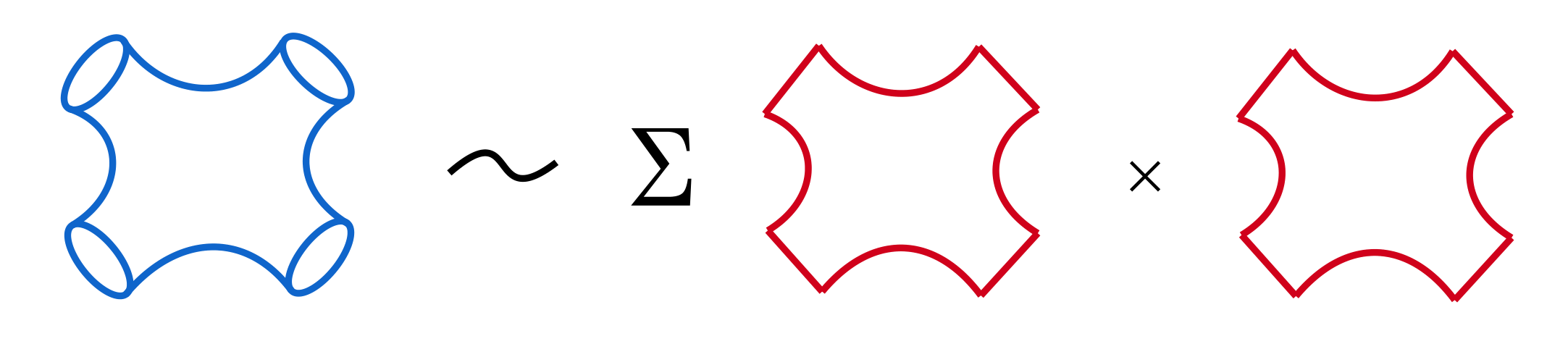
Scattering Amplitudes of Kaluza-Klein Strings and Extended Massive Double-Copy
Yanfeng Hang, et al. •
A massive KLT-like relation connects closed-string amplitudes with Kaluza-Klein states to
products of open-string amplitudes. Its field-theory limit gives a double-copy construction of
massive graviton amplitudes from gauge-boson amplitudes. Exact four-point results agree with
field-theory calculations, with the analysis also extending to five- and six-point scattering.
CosmoPINNs uses physics-informed neural networks to solve the differential systems
governing cosmological integrals. It covers tree-level, one-loop, and two-loop
examples in power-law FRW cosmologies, with transfer learning that reuses features
learned from simpler graphs to train more complex systems.
Lean projects for turning identities and theorems in theoretical physics into
machine-checked proofs. Current topics include cosmological finite-difference
identities and the Kaluza–Klein gravitational equivalence theorem. A local language
model proposes proof steps, while Lean checks each candidate and returns feedback
to guide further attempts.